Thursday, December 29, 2011

Ted Williams, Babe Ruth, Ty Cobb, Lennie Merullo, and me

Here's a little behind-the-scenes story from my book, Oliver's Game:

The man who posed for me as Grandpa Hall actually played for the Chicago Cubs in the 1940's. His name is Lennie Merullo, and he was the starting shortstop for the Cubs the last time they made it to the World Series, in 1945!

I originally just wanted to interview Mr. Merullo, but once he started talking, I realized he was exactly how I pictured Grandpa Hall- just the right age, and overflowing with amazing stories about his days as a big league ballplayer. So I asked if he'd pose for me, and he did.  Mostly he just kept telling stories, and I took pictures.

One of my favorite stories he told was about how he managed to accumulate an incredible collection of three game-used baseball bats that had belonged to Babe Ruth, Ty Cobb, and Ted Williams!

Here he is, in the fake baseball card store I built in my basement:


After the book was done, I was doing a school visit in Reading, Mass. I didn't know it, but Lennie's grand-daughters were students at the school, and he decided to pay me a surprise visit. And he brought something with him- a bag with three baseball bats in it!

They weren't in any sort of protective cases, just 3 old wooden bats in a canvas bag, like he was heading to the field to hit some fungoes. He let me hold the bats, and even swing them. It was pretty surreal to know I was swinging bats that Ted Williams, Ty Cobb, and Babe Ruth actually used in games. Here are a few pictures:

Lennie Merullo, his family, and me, with Ted Williams's bat and Babe Ruth's bat
This was years ago, and looking at these pictures, I'm not completely sure which bat is which. I think this was the Ted Williams bat, since the handle is a bit thinner:

me with Ted Williams's bat
And I think this is the Babe Ruth bat. Or maybe it's the other way around. Either way, what a thrill! I bet there aren't too many bats like this out there, that you can just pick up and swing.

me with Babe Ruth's bat


Wednesday, December 28, 2011

Fenway Memories: The Derek Lowe Poster Incident

Now that Christmas is over, and we're less than 50 days away from the release of There Goes Ted Williams and the new Fenway Centennial edition of Zachary's Ball, I thought I'd turn my attention toward baseball, and start sharing some of my favorite Fenway Park memories here on my blog.

This first one is from 2001, when the Massachusetts Teachers Association used my book, Zachary's Ball, on promotional materials for their Red Sox Reading Game. Posters and bookmarks featuring Red Sox pitcher Derek Lowe reading Zachary's Ball were distributed to every school in Massachusetts, and kids could enter to win tickets to a Red Sox game, just by reading a few books. (I've got some exciting news to share about this program, but I'll save that for later...) The poster was also printed as a full-page ad in the Boston Globe. This was my very first book, and as a lifelong Red Sox fan, this was all extremely exciting for me.
blurry photo of the 2001 Mass Teachers Association Red Sox Reading game poster, featuring Derek Lowe and Zachary's Ball
To top it all off, one night that spring, the MTA gave out 10,000 posters to fans at a Red Sox game. I got to participate in a pre-game event where Derek Lowe read a few pages of the book, then I did a book signing at the souvenir store during the game. The signing only went until the 6th inning or so, then I got to go watch the game. It was pretty cool to look around and see everyone with their posters. Until...

...Derek Lowe came into the game. He was the closer that season, and he was off to a shaky start. Earlier that evening, when he read Zachary's Ball, he started off by apologizing to the crowd because he had just blown two saves against the Yankees during a weekend series in New York.

So he came into the game and proceeded to blow a 2-run lead to Seattle. And the fans reacted the way you'd expect them to- they all started throwing their Derek Lowe posters onto the field. The posters were rolled up with a rubber band, so they flew surprisingly well. The game had to be stopped for several minutes while the grounds crew cleaned up the field.

Here's a picture. Notice the tiny white specs on the warning track. It looked like that all the way around the field.

Fenway Park, 2001. Fans litter field with Derek Lowe/Zachary's Ball posters.

Next time, I'll post a few pictures from the night in 1999 when I camped out at Fenway...

Thursday, December 22, 2011

'Twas the Night Before Christmas... behind the scenes

With Christmas fast approaching, I thought it would be fun to post some photos I took while I was working on illustrating 'Twas the Night Before Christmas (Candlewick, 2002). A lot of work goes into illustrating a book, and much of it takes places before the pencil ever hits the paper. Here's some of what I did to try to bring this story to life.

Every time it snowed during the winter of 2000-2001, I went outside and took pictures. To this day, when I see new-fallen snow, it's hard not to grab my camera. This one is of my backyard, back when I lived in Arlington, Massachuestts. Guess I forgot to put the patio furniture away...


I decided to set the story in Beacon Hill, in Boston, since the buildings in that neighborhood were from the right time period. I spent some time wandering around Beacon Hill, and settled on The Nichols House Museum as the perfect setting. For one, it's a beautiful building. Plus, it's a museum house, so it looks much the same as it looked back in the 1800's. And most importantly, there's a lawn outside! I realized that I needed a house with a lawn, because of the line, "When out on the lawn there arose such a clatter". 

One day I headed into Boston right after a snowstorm and got some great pictures that really helped me envision how I wanted my book to look.

This is the point of view I decided to use for the scene when Santa is landing on the roof.

Same view, different snowstorm.
 
They even let me inside!
 When I draw people, I usually find real people to pose for me. Oftentimes I pose myself, because I know what poses I need, and I'm always there. When I was trying to decide what the narrator should look like, I kept picturing him as my friend, author M.T. Anderson. So I asked him to pose for me, which he did. He was such a good sport about it, and he did an amazing job. This was back before he was a National Book Award winner. I bet he doesn't do this sort of thing anymore!

Tobin Anderson kindly posing as the narrator in 'Twas the Night Before Christmas, while my then-girlfriend, now-wife Sarah works as lighting technician. I'm sort of the director at this part of the process.
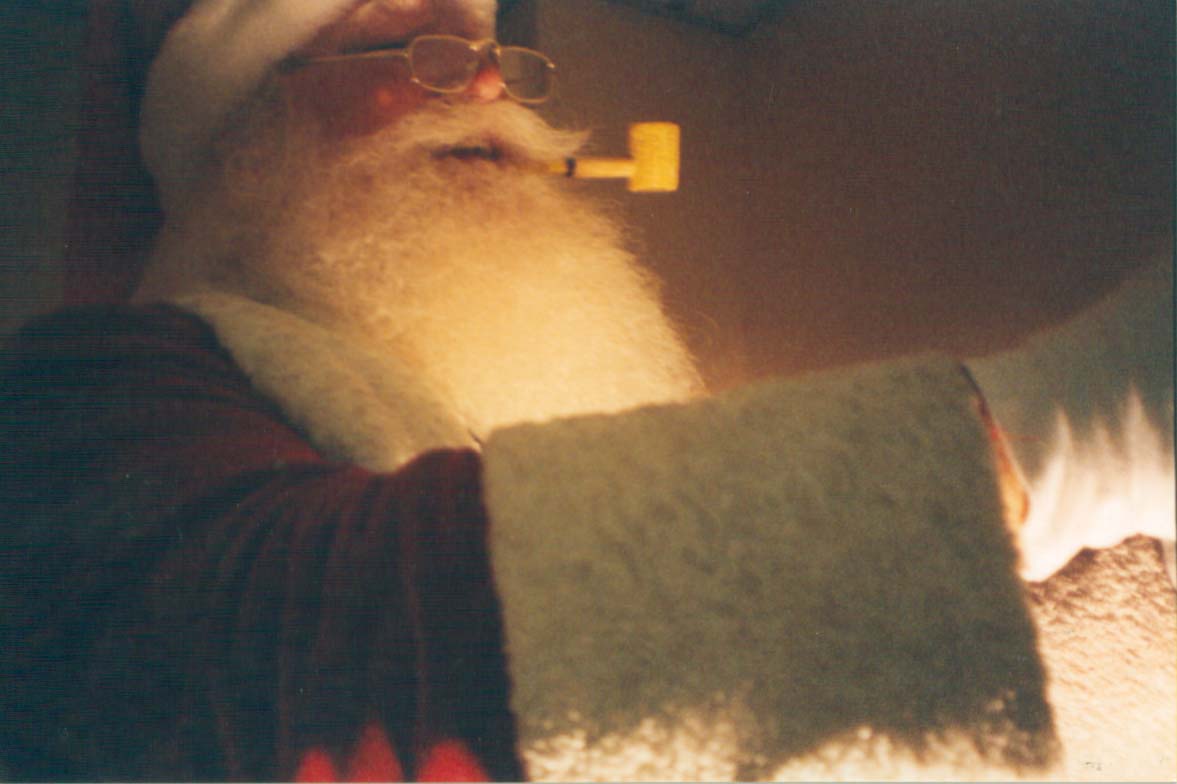
I wanted to make sure Santa looked really good in my book, so I went right to the big guy himself. He took a few minutes out of his busy schedule to pose for me.  Fortunately he was at the mall, so I didn't have to go all the way to the North Pole (good thing, because I didn't have any money!).


My wife, Sarah, remembered that there was a barn full of old sleighs and wagons at the horse farm where she used to work when she was in high school. So we took a road trip up to Maine, and found this amazing red sleigh, which I used as the model for Santa's sleigh:

sidenote: I used a slightly altered version of this sleigh in Over the River and Through the Wood
I set up this fake Christmas tree in my basement, with nineteenth century decorations. It was up for about a year. It got really dusty.


Sarah and I were on vacation in New Orleans when I found this great model reindeer. Sure, I probably could have found it at a store in Boston, but I bought it. His antlers mostly survived the plane ride. I would hang him in front of my drawing table while I was drawing.


And my mother-in-law's cat, Oscar, kindly agreed to pose as the cat.


Happy Holidays, everyone! Thanks for reading my blog.

-Matt

Monday, December 19, 2011

new batch of Gingerbread Pirates!

Arrrr, mateys! There are a whole lot of Gingerbread Pirate cookies being made these days! If you make your own crew, please send me a picture at matt@tavaresbooks.com or post it on my facebook page, and I'll post it here sometime before Christmas.

Here's this week's swashbuckling batch of homemade gingerbread pirates:


Friday, December 16, 2011

Ted Williams, Arthur Griffin, and me...

I've got some very exciting news about my upcoming book, There Goes Ted Williams. But first, a little background...

One day during the 1939 baseball season, acclaimed photographer Arthur Griffin spent a couple hours at Fenway Park, taking pictures of lanky Red Sox rookie, Ted Williams. Griffin took several rolls of pictures using his usual 35mm black and white camera, but he also brought along a new 4"x 5" view camera, because Eastman Kodak had asked him if he would test out their newly-created color film.

These color photos that Griffin took of Ted Williams back in 1939 are some of the most beautiful baseball photographs I've ever seen, and the very first color photographs ever taken of Ted Williams. It's amazing to see him in full color at 20 years old. You can tell why they called him "The Kid".

You my have seen some of these pictures without even realizing it. Remember this image of Ted Williams that graced the cover of Sports Illustrated after he passed away in 2002? This is one of the pictures Arthur Griffin took that day in 1939:


Fast forward to October of 2011. A family friend visited my parents, and brought a gift to pass along to me- two photographs of Ted Williams that had belonged to her husband, a childhood friend of my father's, who passed away recently. They didn't mean much to her, and she thought I might appreciate them, since she knew I had been working on a book about Ted Williams. Here they are:


I've got them up on my studio wall, and I just keep staring at them. Two 11 x 14 color prints, taken by Arthur Griffin that day in 1939, autographed by Arthur Griffin AND by Ted Williams! 

I'm sure she could have gotten a lot of money for these treasures, and I'm blown away that she decided to give them to me. Here's a closer look at each:

I think this one is my favorite, because it captures Ted Williams so well. Even when he's posing with his glove, he's still working on his batting stance.

Or maybe this one is my favorite...
Getting this amazing gift gave me an idea. I was hoping to find somewhere in the Boston area to host a launch party for There Goes Ted Williams. Seeing these pictures made me think that maybe the Arthur Griffin Museum in my hometown, Winchester, Massachusetts would be the perfect place. I could sign copies of my book while people enjoy an exhibit of Arthur Griffin's amazing Ted Williams photographs.

To make a long story slightly less long... I mentioned the idea to Judy Manzo, bookseller extraordinaire and owner of my hometown independent bookstore, Book Ends. She loved the idea, and offered to show an advance copy of the book to the people at the Arthur Griffin Museum, which she did. Their response was so much better than I even hoped for. They don't just want to host a launch party. They want to host an exhibit of Arthur Griffin's 1939 photographs AND my original artwork from my book, There Goes Ted Williams!

So that's the exciting news! I'll have more formal promo materials as the date approaches, but for now, here are the details:

There Goes Ted Williams: Matt Tavares and Arthur Griffin
The Griffin Museum of Photography, in Winchester, Mass
Exhibit will run April 5 through May 27, 2012
Opening reception: Thursday, April 12, 7:00-8:30pm
Artist talk and book signing:  Sunday, April 22, 3:00pm
(signed books will also be available at the opening reception)

Winchester's excellent independent bookstore, Book Ends, will be handling book sales at both events.

I'm really looking forward to this, and I'm so honored to know that my Ted Williams illustrations will be up on the wall with Arther Griffin's photographs. If you're anywhere near Winchester, Mass, I hope to see you at the opening!

illustration from There Goes Ted Williams: The Greatest Hitter Who Ever Lived, by Matt Tavares


Wednesday, December 14, 2011

For Aspiring Authors and Illustrators...

As an author-illustrator of children's books, I hear from a lot of people who are trying to get started in the children's book business, but don't know where to begin. Sometimes they've written a story and they want me to illustrate it. Sometimes they just have an idea, and they want me to write and illustrate it (then we'd split the money, I guess...). Most often, they just want to start the process of trying to get published, but aren't sure what to do first.

Everyone's path to getting that first book published is different, but I thought it might be helpful to write a blog post to help point people in the right direction. Some of this is for author/illustrators, and some is just for authors (who aren't also illustrators). I hope it helps! If there's anything I missed, please leave a comment and I'll try to answer any questions you might have.


IF YOU WANT TO BE A CHILDREN'S BOOK AUTHOR, ILLUSTRATOR, OR BOTH:

For anyone hoping to break into the children's book business, whether you're an author, an illustrator, or an author/illustrator, the absolute very best place to start is to join the Society of Children's Book Writers and Illustrators. I'm pretty sure it only costs $70 to join, so it's not a huge investment. You should do this right now. I will wait.


Welcome back! As a member of SCBWI, you now have access to tons of information about how to get your story published, including lists of publishers, what type of books each publisher makes, which publishers accept unsolicited manuscripts (for many publishers, you need to have an agent or they won't even read your story). They also have a list of agents accepting new clients, and online message boards where you can connect with other writers, illustrators, etc., and find answers to any questions you might have. Their web site is scbwi.org.

Another great reason to join SCBWI is their regional and national conferences, where editors and art directors from all the major publishers review manuscripts and portfolios. This is the only way for new authors and illustrators who don't have an agent to get their foot in the door with certain publishers.

For example, Candlewick Press, who has published most of my books, only accepts submissions from literary agents. But they always send their editors and art directors to SCBWI conferences. They see the SCBWI conference as a sort of filter. They know that anyone who has taken the initiative to join SCBWI and devote the time to attend a conference is serious about it, as opposed to when they tried accepting unsolicited manuscripts, some of which were scrawled on notebook paper, and most of which was not anything that would ever get published.

Some publishers do accept unsolicited manuscripts, and SCBWI provides you with a list of them too.

FOR ASPIRING AUTHORS (who aren't also illustrators):

If you've written a book and you're in the process of finding an illustrator, I've got good news! You can stop searching RIGHT NOW! Unless you are planning on illustrating it yourself, you should submit your story to publishers with no illustrations. Even if it's a picture book. It sounds crazy, but it's true.

A lot of aspiring authors waste valuable time searching for an illustrator, not realizing that publishers would prefer to have them submit their manuscript without any illustrations- which is actually a good thing, because you can skip right to the next step, trying to find a publisher who might like your story.

Here's how it typically works: the author submits the un-illustrated manuscript to the publisher, then if the publisher likes it, they offer the author a contract. Next, the publisher finds an illustrator that they feel is a good match for the manuscript, and offer the illustrator a contract. Usually, the author and illustrator never even meet, and everything goes through the publisher.

People often come up to me and tell me they've got a great idea for a children's book, and they want me illustrate it. Every illustrator I know has stories about their neighbor, or their second cousin, or their ex-girlfriend's mom, asking them to illustrate their unpublished story. I'm never quite sure what to say in these situations, because I know any answer will probably make them think I'm a jerk. But I guess it all boils down to this: Illustrators get illustration jobs from publishers, not from authors.

Maybe you wrote a great story, and maybe you think I would be the perfect illustrator for it. And maybe you're right. But if you send me your story, I can tell you right now that my answer will be "no". But not because I'm a jerk, and not because your story isn't any good (I haven't even read it!).

When I take on a new project, not only do I need to feel passionate enough about it that I want to spend seven to nine months working on it, but I also need to know that I'll be working with an editor and an art director who will help me make a great book, and I need to know that it will be distributed to bookstores and libraries, and it will have the support of a marketing department.

This is how I make my living. This is how I pay my mortgage and support my family. That's why I only take illustration jobs from publishers, who pay me an advance and royalties, and get my books into bookstores and libraries. So if you want me (or any other illustrator) to illustrate your story, first find a publisher, then tell your editor you think I'd be a good fit. And if they agree, they'll send it to me!

SOME MORE GENERAL ADVICE FOR ANYONE GETTING STARTED:

-Spend some time in the children's section at your local bookstore, so you can get a sense of what kind of book yours might be, and what publishers might be interested in such a book.

-Find some of your very favorite children's books, the ones you think are the greatest books ever made (For example, I might pick The Polar Express, or Make Way for Ducklings), and try to make your book BETTER! If your book isn't better than those books (and it probably isn't), try to figure out why. What do those books have that your book lacks?

Sure, you might fall short of your goal here, but it's a good way to improve your work and get the most out of yourself. And it's a heck of a lot better way to approach it than what I hear from a lot of people, who basically say, "Why isn't my book getting published? It's better than most of the crap out there!" Maybe it is. But if you start off your career by comparing your book to books you think are crap, I think you might be heading down the wrong path.

-Maybe this is obvious, but if you're an illustrator, you should set up a website with some samples of your best work. If an editor or art director is considering publishing your book, they're going to google your name. Make sure you have something impressive for them to see when they do. They might like your illustration style and want to see what else you've done. They might see the book you're submitting, and even if they aren't crazy about it, maybe your style is a good fit for a manuscript they're working on and you'll get your first book deal that way.

-As much as you have poured your heart and soul into this book you're shopping around, don't get too attached to the work you've already done. When Candlewick Press decided they wanted to publish my senior thesis (which ended up being Zachary's Ball), they told me up front that they saw it as a really good rough draft, and they wanted to rebuild the book with me. I ended up doing almost all new pictures and revising the story. I was 22 at the time, and some of the people I was working with had been making children's books for longer than I had been alive, so I listened and took their advice and learned a lot.

-One last thing that might sound obvious, but I think it's important to remember: your focus needs to be on making yourself the best writer and/or illustrator you can be. I think sometimes people get so caught up in the "trying to get published" part that they lose focus on the "working hard to become a really good writer and/or illustrator" part. Keep practicing, and keep getting better.

I hope this helps. Good luck!